Growth Planning
See what it takes to hit the plan.
Connect the pipeline you have with the growth you need. Test assumptions about demand, conversion, deal size, and timing. See what each path asks of the business.
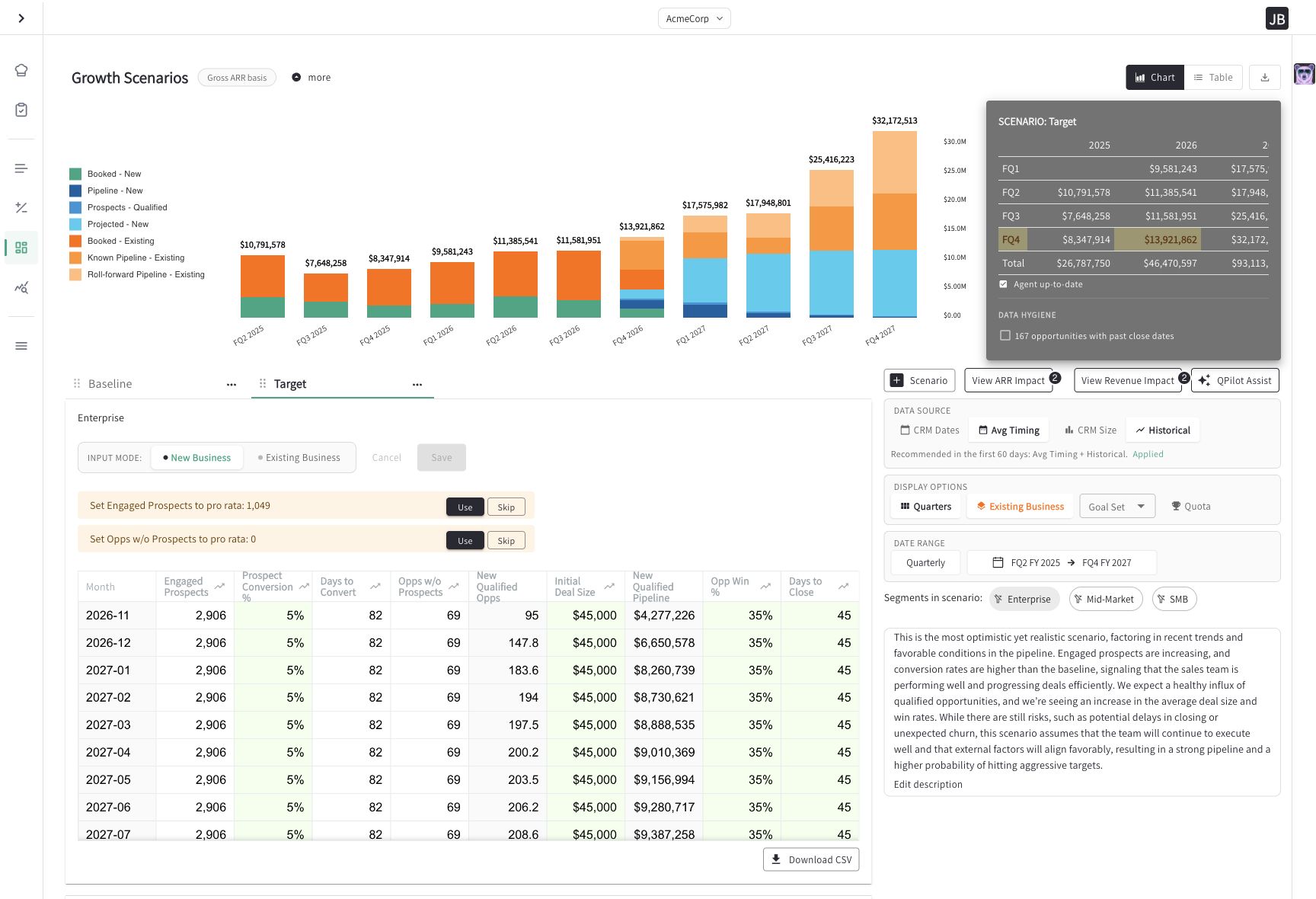
Connect the quarterly outlook to its monthly operating assumptions. Compare scenarios and see what needs to change to reach the plan. Values use a Gross ARR basis.
Trusted by








Put the assumptions behind the target.
A growth discussion becomes more useful when you can name the changes it depends on. Work through the drivers by segment and month, then review their combined effect.
Demand
How much new pipeline do we need?
Plan engaged prospects and additional opportunities by segment and month. See how those inputs translate into qualified pipeline.
Conversion
Where does the plan depend on a better win rate?
Inspect the assumptions for prospect conversion and opportunity wins. Compare the improvement you need with historical performance.
Deal size
What if the mix shifts toward smaller deals?
Model deal value by segment. Make the contribution from each part of the business visible instead of relying on a company-wide average.
Timing
What happens if deals take longer to close?
Test prospect conversion time and sales-cycle assumptions. Understand which outcomes move when the timing changes.
Keep the current quarter in the conversation.
Start with the opportunities already in play and the team's forecast. Then explore how much future growth depends on pipeline that still needs to be created.
- Review the pipeline supporting the current call.
- Separate booked business from projected outcomes.
- Make the gap to the target part of the planning discussion.
Ground the longer-term plan in the current deal forecast. Inspect cumulative buckets, goal coverage, and data-quality exceptions together. Values use a Gross ARR basis.
Give the team a plan it can challenge.
Make the starting point, assumptions, and alternatives visible. Finance and revenue leaders can work through the trade-offs using the same business context.
- Ground the starting point
- Bring booked business and current pipeline into the discussion. Use historical metrics to put the proposed assumptions in context.
- Make the alternatives explicit
- Keep a baseline and the alternatives you want to explore. Give each scenario a clear description so the team knows what it is evaluating.
- Revisit the plan with actuals
- Compare the latest performance with the assumptions. Focus the next review on what changed and which decisions need to follow.
Bring the AI you already use
Explore the alternatives. Keep the reasoning reviewable.
QFlow gives Claude and Codex governed business context and deterministic execution. Use recipes and published skills to investigate performance, revisit planning assumptions, and explain what changed.
Bring the inputs and calculations into the review with the narrative. The team can question an assumption and rerun the analysis without rebuilding the process.
Explore QFlow DesktopBefore your next planning session
How is growth planning different from the sales forecast?
The sales forecast focuses on current opportunities and the team's judgment about what will close. Growth planning extends that view with assumptions about future demand, conversion, deal size, and timing. Use both to connect the current-quarter call with the longer-term plan.
Can we use different assumptions for each segment?
Yes. Scenarios support segment-level, monthly inputs. For example, Enterprise and SMB can have different deal sizes, conversion rates, and sales cycles. The resulting outlook brings those assumptions together while keeping their contributions visible.
Can we compare a baseline with a target scenario?
Yes. Load saved scenarios and review their inputs and projected outcomes. A useful comparison makes the differences explicit: what must change, when it must change, and which segments contribute to the result.
Does the scenario show bookings, ARR, or revenue?
Keep the metric basis visible when reading a scenario. The product view on this page uses Gross ARR. QFlow also provides ARR and revenue impact views, using the relevant source data and configuration. Bookings, ARR, and recognized revenue answer different questions and should not be treated as interchangeable.
Where does AI fit into the planning process?
Use QFlow's governed context, recipes, and published skills to make planning analysis repeatable with Claude or Codex. AI can investigate changes and explain the trade-offs; explicit inputs and deterministic calculations keep the numerical work reviewable. Your team owns the assumptions and the decisions.
Make the next growth decision with the assumptions in view.
The pipeline you have. The drivers you can change. The outcomes you need to understand.
QFlow holds a SOC 2 report covering Security, Availability, Processing Integrity, Confidentiality, and Privacy. Learn more in the QFlow Trust Center.